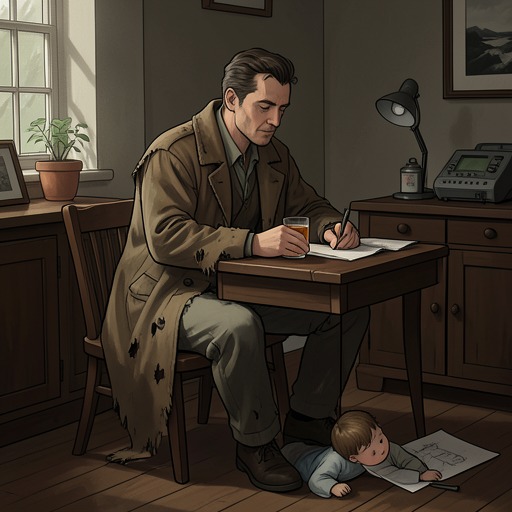
Alcoholism and “the craving”
Angela's AshesAlcoholism and “the craving” are not a private excess separated from family life: in the McCourt household, drinking repeatedly absorbs the money meant for food, recurs beside bereavement, and leaves children to encounter its consequences before they can understand it. The memoir makes the pattern legible through concrete returns—the absent wages, the whiskey smell, the songs, the empty pockets—and through a child’s memory that carries the same recognition from Brooklyn into Limerick and, much later, into confession.
A pattern established in the family
The narrator begins by identifying the shiftless, loquacious alcoholic father as one element of the miserable childhood he remembers, alongside poverty, a defeated mother, priests, schoolmasters, and the history of English rule. The naming is blunt, but the book’s account of drinking is made through recurring household circumstances rather than a detached definition: work may bring in wages, relief may be collected, and food may be promised, yet the family cannot count on that money reaching the table.
The return from New York does not end the pattern. In Brooklyn, the father can come home with the smell of whiskey; when the family later searches bars near the Long Island Railroad Station, the children recognize the stale smells as reminders of him. Their mother goes into the bars or sends Frank in to ask whether his father is there. The search makes drinking a family ordeal: the missing man is not merely absent from supper but becomes the object of an anxious, public hunt, while the children wait with their mother and the pram.
The father’s own explanations do not undo the consequences. At home he may drink tea, eat nothing, tell stories, show the children words in the Daily News, or smoke and stare at the wall. He says food is a shock to the system. These quieter gestures coexist with the sharper pattern that the children learn: he can speak and sing with them, but the household cannot rely on him to turn work into food.
Wages, hunger, and the search for help
The pattern becomes especially clear when the father’s job reaches its third week. He does not bring home the wages. On Friday night the family has bread and tea while other working families along Classon Avenue eat eggs; the contrast between those meals gives the missing pay a visible, domestic measure. The mother says the boys have gone to bed half hungry because their father has filled his belly with whiskey. The next morning she asks whether he will bring home that night’s wages or drink them again, making the family’s immediate need—not an abstract judgment of character—the subject of the confrontation.
When the father is missing, the mother’s practical decisions expose how survival is assembled around his absence. In a Brooklyn bar, she asks the bartender to fill the twins’ bottles with water and perhaps sugar. At Frank’s request, the bartender instead gives the babies milk, explaining that it is better for their teeth and bones; the mother accepts what she can get. Back on Classon Avenue, she tells the Italian grocer her husband is late, probably working overtime, and asks for a few things on credit. The grocer trusts that she will pay sooner or later and lets her take what she needs. A meal therefore depends on neighboring acts of help and credit after the expected wages fail to appear.
The scene in Limerick repeats the same economic problem under different conditions. After Oliver’s burial, the father says he will collect the week’s dole—nineteen shillings and sixpence—and return by noon with coal, food, and perhaps sweets in the child’s imagined tribute to Oliver. He does not come home by noon, or later in the afternoon; the family boils the potatoes given by shopkeepers the day before. After dark, he returns singing. The promised relief has again failed to become the meal the children were told to expect.
The mother’s application for assistance shows that formal relief cannot be treated as an easy substitute for reliable wages. The men assessing her need give her a docket for a week’s groceries at McGrath’s on Parnell Street and a separate docket for coal from Sutton’s yard on Dock Road, while warning that the assistance will not be weekly and that they will inspect the household. The dockets address the immediate shortage, but their limited duration and review conditions leave the family’s dependence unresolved. Across credit, charitable groceries, coal, and the dole, the book records an improvised economy in which drink can consume the money expected to sustain the household.
Drinking amid grief and patriotic song
Alcohol’s hold is shown not only through its cost but through its recurring association with the father’s songs and declarations. In Brooklyn, he returns singing after the family has waited without wages; he calls the boys his troops and offers them a nickel each if they promise to die for Ireland. His nationalist language turns a hungry night into a performance of collective heroism, but the mother’s rebuke names the intimate cost: the boys have gone to bed half hungry while their father has spent his money on whiskey. The patriotic pose does not cancel the domestic fact beneath it.
After Margaret’s death, the father disappears on what the child calls a cigarette hunt and returns two days later with the smell of drink. He puts Frank and Malachy at attention in the kitchen and makes them promise to die for Ireland; the boys agree, and together they sing “Kevin Barry.” The ceremony folds drinking, grief, and national feeling into one repeated scene. The father’s songs provide a language for sorrow and belonging, yet their recurrence also marks the return of a man whose actions have left the family without dependable support.
The consequences are particularly stark after Oliver’s death. The father carries Frank through Limerick seeking food from shopkeepers for a family with two dead children and three more in danger for want of food and drink. Some give bread, potatoes, or tins of beans; others direct him to public assistance. He says he is glad to see the spirit of Christ alive in Limerick, but shopkeepers answer that a man with his northern accent should not lecture them about Christ while dragging a child around like a beggar. The appeal for food becomes another confrontation between the father’s language of dignity and the family’s material need.
Even after that appeal succeeds in gathering some food, the father meets Pa Keating and accepts a pint. He soon sings “Roddy McCorley,” “Kevin Barry,” and other songs, crying over Margaret, who died in America, and Oliver, who died in the City Home Hospital. Frank is frightened by the loud singing and crying and wishes he were at home with his brothers and mother. When the barman says the father has had enough and should take the child home, the father asks for one more pint and resists being led away. Grief is real in the scene, but so is the pattern: drink takes precedence again, even while the child accompanying him longs to return to the family.
Recognition across places and time
The child’s recognition of the whiskey smell links the Brooklyn episodes to Limerick rather than letting migration appear to have reset the family’s life. After the family has returned to Ireland, the father’s drinking is still familiar by scent; the narrator explicitly recalls the smell from America when his father embraces him after the dole money has gone. In that moment, the father cries over Angela, Margaret, and Oliver, while Frank is hungry and has no words. The embrace carries affection and sorrow, but the familiar smell also identifies the continuity of the harm.
The same association persists in the narrator’s later account of what troubles him. In speaking to Saint Francis, he lists Margaret, Oliver, and Eugene; his father singing “Roddy McCorley” and bringing home no money; and his father sending no money from England. This later recollection places drinking within a wider history of family loss and abandonment rather than as an isolated incident. The songs remain in memory alongside the missing money, joined as an image of the father’s presence and failure.
The memoir does not reduce the father’s grief to a disguise for drinking. It shows him beating his thighs and crying after the children’s deaths, carrying Frank to ask for food, and weeping as he sings. But those moments of grief coexist with his repeated failure to bring home wages or relief money. The tension is central to the portrayal: the father can be loving and mournful, yet the child’s hunger remains, and the mother must find credit, assistance, or food elsewhere.
The craving as a household force
The account’s recurring sequence gives “the craving” its force without presenting it as a clinical explanation. Work or relief creates an expectation of money; the expected money does not appear; the family waits, eats little, or seeks help; and the father returns with the smell of drink and a song. Each recurrence changes the household’s circumstances, while its familiarity makes the child increasingly able to recognize the pattern. The narration’s concrete measures—bread and tea instead of eggs, milk in baby bottles, grocery and coal dockets, nineteen shillings and sixpence—show what the repeated cycle means in daily life.
The narrator’s adult recollection retains the limits of what the child could understand. He registers hunger, smell, absence, and fear before he can make a complete account of his father’s conduct. Later, he can place those childhood scenes among the troubles he voices in confession, but he still describes the remembered events rather than offering a diagnosis. That movement from sensory recognition to retrospective naming makes the pattern both personal and social: it is bound to one father’s repeated drinking, but it unfolds within poverty, uncertain work, and a household forced to depend on shops, neighbors, charity, and relief.
The book’s measure of alcoholism is ultimately relational and material. Drink repeatedly separates the father from the duties his family depends on, while songs and declarations promise a larger fellowship—soldiers, Ireland, the dead—that cannot feed the children. Against those promises stand the mother’s questions about supper, the grocer’s open account, the milk-filled bottles, and the dole that never reaches home on time. “The craving” is therefore rendered not as a single dramatic episode but as a cycle whose costs return in the same places: at the table, in the children’s hunger, and in the family’s memory.